



Researcher Yuejun Chen from the Center for Excellence in Brain Science and Intelligence Technology, CAS Visited APM
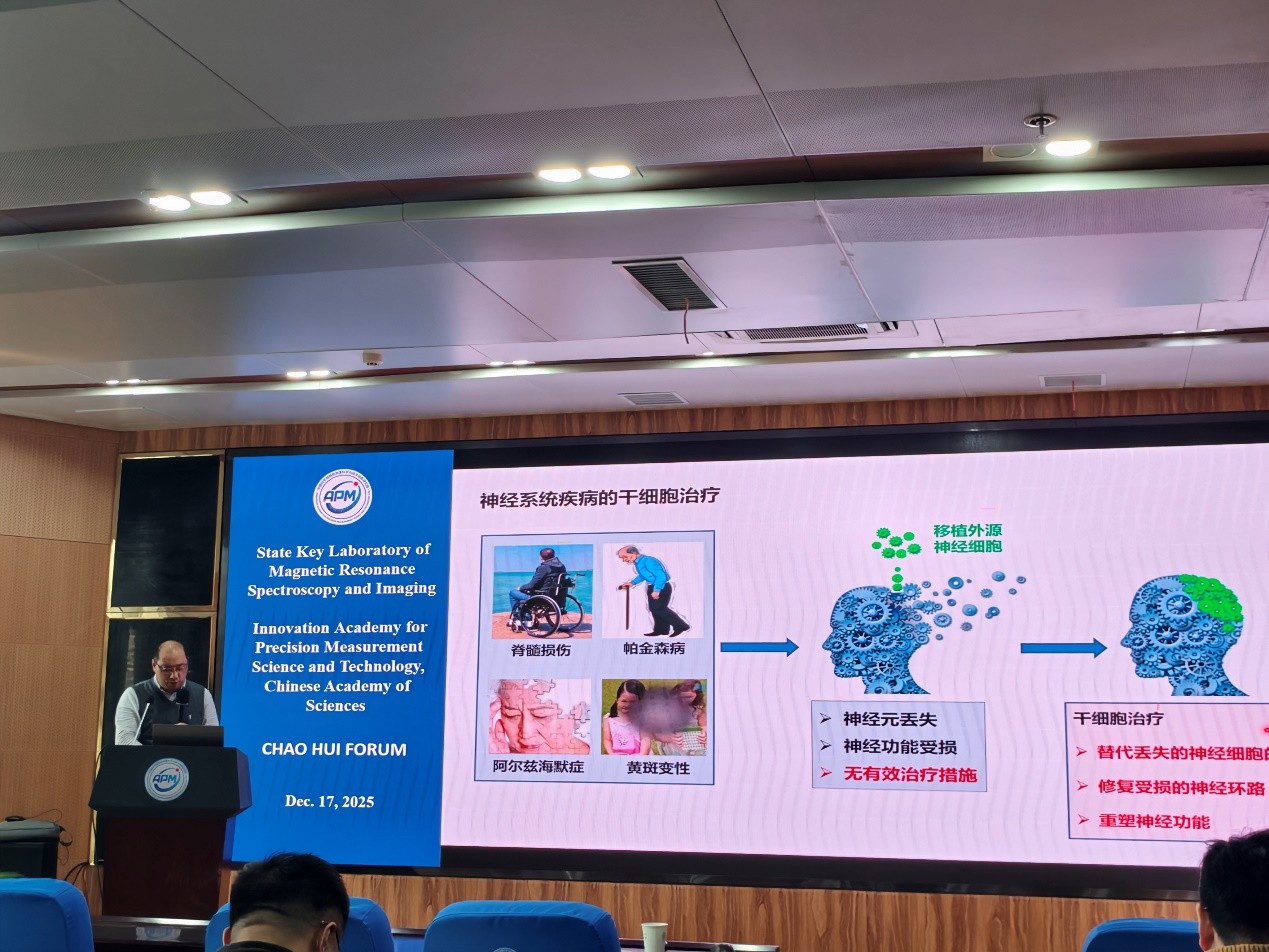
On December 17, 2025, Researcher Yuejun Chen from the Center for Excellence in Brain Science and Intelligence Technology (formerly the Institute of Neuroscience), Chinese Academy of Sciences, was invited by the State Key Laboratory of Magnetic Resonance Spectroscopy and Imaging to deliver an academic report titled "Stem Cell Therapy for Parkinson's Disease" in Conference Room 428.
During the report, Researcher Yuejun Chen introduced a novel high-throughput monoclonal lineage tracing technology developed by his team for both in vivo and in vitro applications. Utilizing this technology, they systematically elucidated the differentiation and developmental lineage of dopaminergic neurons. Based on this lineage, they successfully achieved high enrichment of transplantable precursor cells by screening specific surface marker molecules. Post-transplantation, the cells achieved functional integration and structural incorporation in vivo, demonstrating excellent therapeutic effects for Parkinson's disease in animal models. Furthermore, they have advanced clinical translation domestically and internationally, having initiated stem cell therapy clinical trials for multiple Parkinson's patients, with preliminary efficacy already observed. Researcher Chen's presentation demonstrated the complete pathway for Parkinson's stem cell therapy, spanning from technological development and preclinical validation to clinical translation, highlighting its significant clinical application value.
Participants engaged in in-depth discussions and exchanges with Researcher Yuejun Chen regarding the safety evaluation, druggability, prospect assessment, and applicable subtypes of Parkinson's stem cell therapy.
Background of Yuejun Chen:
Yuejun Chen earned his bachelor's and doctoral degrees from Shanghai Medical College of Fudan University, under the supervision of Academic Ma Lan. He conducted postdoctoral research at the University of Wisconsin–Madison with Professor Su-Chun Zhang. Currently, he serves as a Senior Researcher at the Center for Excellence in Brain Science and Intelligence Technology (formerly the Institute of Neuroscience), Chinese Academy of Sciences. He is a recipient of the National Science Fund for Distinguished Young Scholars, the National Science Fund for Excellent Young Scholars, and the Excellent Young Scientists Fund Program (Overseas). His primary research focuses on the neural differentiation of human pluripotent stem cells and cell therapy for neurological diseases. He has developed original technologies, SISBAR and CREST, enabling high-throughput developmental lineage tracing in vitro and in vivo, respectively. He has deciphered the differentiation lineage of dopaminergic neurons and, based on this, developed safer and more effective novel cell therapy strategies for Parkinson's disease. His work also includes elucidating new mechanisms of grafted cell circuit integration and function in Parkinson's cell therapy. His research findings have been published as corresponding author (or co-corresponding author) in prestigious journals including Cell Stem Cell (6 papers), Nature Methods, Journal of Clinical Investigation (2 papers), and Brain. He has applied for 10 invention patents, with 2 already licensed. His technological achievements received the Excellence Award at the 2024 National Disruptive Technology Innovation Competition, the First Prize (2010) and the Second Prize (2012) of the Natural Science Award from the Ministry of Education. Based on his research outcomes, he has initiated clinical translation. The original Parkinson's cell therapy drug developed by his team has obtained Investigational New Drug (IND) approvals in both China and the United States, has been designated for the FDA's Fast Track program, and a registered clinical trial has been launched in collaboration with Shanghai Ruijin Hospital, preliminarily validating the safety and efficacy of stem cell therapy for Parkinson's disease.

Innovation Academy for Precision Measurement Science and Technology, CAS.
West No.30 Xiao Hong Shan, Wuhan 430071 China
Tel:+86-27-8719-8631 Fax:+86-27-8719-9291
Email:hanyeqing@wipm.ac.cn
鄂ICP备15017570号-1
